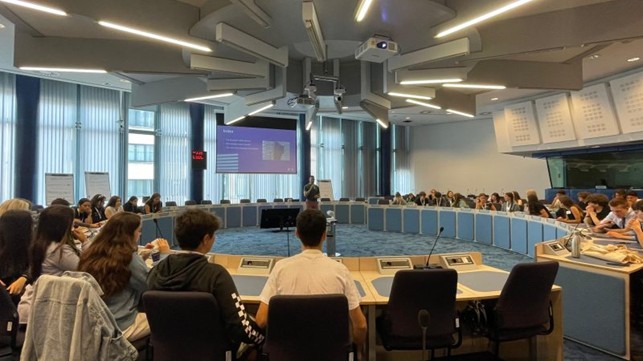
On the morning of July 8th, students from across Europe gathered at the European Commission headquarters in Brussels, marking the official start of the EU Demos Summer School, a week-long initiative that runs from July 7th to 12th.
EUdemos is a project funded by the European Union through the Erasmus+ Programme, aimed at the integration of European affairs and matters into school subjects through interactive and pedagogical activities. The program is coordinated by the Royal University Institute of European Studies at CEU San Pablo University in Madrid, and includes CEU schools, as well as partner institutes from Portugal, Poland, Greece, and Italy. A group of students from each participating school will represent their own institute.
The aim of the project is to empower teachers and trainers through curricular and extracurricular activities in order to enhance their professional development and expand the study of European affairs in schools and institutes.
The summer school, hosted at the heart of the European Union, offers students the unique chance to visit key European institutions and learn how the EU works through a series of interactive activities.
The first institutional stop was the European Commission, housed in the Charlemagne Building, where participants were introduced to the structure, powers, competences, and responsibilities of the executive branch of the EU. A Commission official explained the key roles of the institution: the European Commission holds the right of initiative, and the competence of policy and budget implementation. Moreover, the Commission is the guardian of the treaties, and the representative of the EU at the internation level. Additionally, the composition of the Commission was discussed, including the President, the Commissioners, and the Executive Vice Presidents, highlighting its role in shaping and enforcing EU law and policy.
Students were particularly engaged when the discussion turned to youth-focused programmes. The Commission official presented two opportunities funded by the Union: DiscoverEU, which offers young Europeans the opportunity to travel across the continent with free rail passes to explore the different countries of the EU and their cultures, and the Erasmus+ programme, which fosters education, training, and youth exchanges across Europe.
This introductory session provided a foundational understanding of how the EU operates, and allowed students to consider how they might engage with the Union as young citizens. It set the tone for a week that promises to be a unique opportunity to connect, learn, and grow as young European citizens.
[Edit By Matilde Sardo]